

Most websites launch into silence. No audience waiting on the other side, no early subscribers, no social buzz. Just a quiet first day and a slow crawl toward traction that could have started weeks earlier.
Here is what happens when you skip a coming soon page: you miss the window where visitors could become subscribers, subscribers could become advocates and advocates could become your first paying customers.
This post breaks down 12 of the best coming soon landing pages from real brands across different industries.
For each one, you will find what the page does, why it actually works and what you can take away and apply to your own pre-launch strategy.
If you are also looking for tools to build your own page, Launch Guard offers a coming soon page to help you create one efficiently.
Why a Coming Soon Page Matters Before You Launch
Before diving into the examples, here are a few numbers worth keeping in mind:
- The median landing page conversion rate across all industries is 6.6%, based on Unbounce’s Q4 2024 analysis of 41,000 landing pages and 464 million visitors (Unbounce, 2024)
- Landing pages with social proof, such as testimonials and trust signals, convert 34% better than those without (Invesp, 2024)
- Email visitors convert 77% more than paid search visitors when the landing page is built specifically for the campaign (Unbounce, 2024)
- 82.9% of visitors access landing pages via mobile, making mobile optimization non-negotiable (SEO Sherpa, 2025)
- Adding a countdown timer to a coming soon page can increase urgency-driven signups by approximately 10 to 15% when paired with a clear deadline
These numbers apply to landing pages broadly and coming soon pages are no exception. A well-built pre-launch landing page before launch is one of the highest-return investments you can make before a product or site goes live.
Best Coming Soon Landing Pages Examples
The 12 examples below are organized into four categories: minimalist designs, creative and interactive pages, SaaS and startup pages and ecommerce examples.
Each one was selected based on how clearly it communicates value, how effectively it captures leads and how intentionally it uses design.
Minimalist Coming Soon Pages That Convert on Clarity
Some of the best coming soon landing pages are also the simplest. These brands stripped everything down to one message and one action and it worked.
1. Robinhood
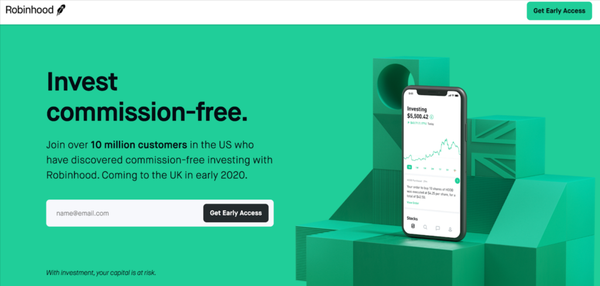
Before Robinhood processed a single stock trade, its pre-launch page was live on the internet with one line: “Commission-free stock trading. Stop paying up to $10 per trade.” That was the entire pitch. No product screenshots, no feature list. Just a dark background, a smartphone mockup and an email signup field.
What the Page Did
- Delivered a single, specific value proposition that was impossible to misunderstand
- Placed visitors in a gamified queue where referring friends moved you higher up the waitlist
- Used FOMO as its core psychological lever: your spot was visible and others were catching up
Why It Worked
The referral mechanic turned every subscriber into a recruiter. Within 24 hours of launch, the page hit number one on Hacker News and collected 10,000 signups. Within a week, it reached 50,000. A year and a half later, the waitlist had grown to nearly one million. The page generated so much buzz it reportedly helped Robinhood secure $13 million in funding before a single user was onboarded.
Key Takeaway
When your value proposition is genuinely disruptive, let it do the work. One specific, bold claim beats a paragraph of features every time.
2. Dropbox
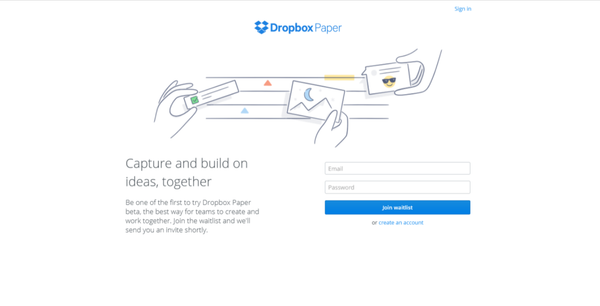
Dropbox’s original pre-launch page famously featured a short explainer video rather than a written description. The video, a simple screen recording walking through what the product would do, sat above a single email signup form. Nothing else competed for attention.
What the Page Did
- Used a 3-minute demo video to do what text couldn’t: show the product working before it actually existed
- Kept the form to one field, email only, with no distractions around it
- Made a direct promise: “Your files, everywhere”
Why It Worked
The video, released overnight, grew Dropbox’s waitlist from 5,000 to 75,000 signups. The product was not built yet. There was nothing to download. But seeing it work was enough to convince tens of thousands of people to hand over their email addresses. The page ultimately supported 3,900% growth in 15 months, scaling from 100,000 to 4 million users.
Key Takeaway
If your product is hard to explain in words, show it. A short demo video on a pre-launch landing page can close the gap between curiosity and conversion faster than any amount of copy.
3. Superhuman
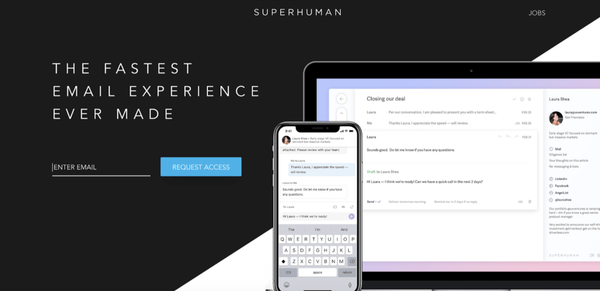
Superhuman’s coming soon page made a bold promise in large text: “The Fastest Email Experience Ever Made.” Below it, desktop and mobile product screenshots showed what that claim looked like in practice. A single “Get Early Access” button led to an application form rather than an instant signup.
What the Page Did
- Used extreme exclusivity as the core mechanic: you had to apply to be considered, not just sign up
- Showed product imagery to make the claim tangible
- Charged $30 per month from day one, which the page communicated upfront
Why It Worked
Superhuman built a waitlist of 180,000 people for a $30 per month email client. The exclusivity was the product. Each invitation felt like a golden ticket, which triggered organic sharing. The coming soon page turned the waiting list itself into a status symbol. Even years after launch, the waitlist mechanic continued driving demand.
Key Takeaway
Scarcity and selectivity can be more powerful than openness. An application-based pre-launch page filters for high-intent users and makes access feel valuable rather than free.
4. Mint.com
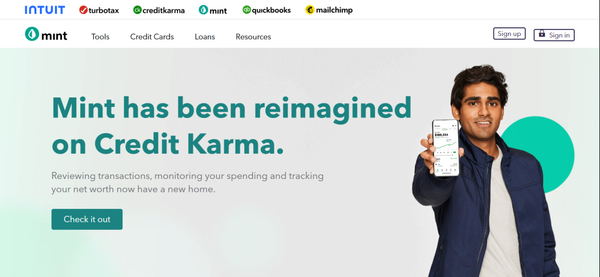
Mint, the personal finance tool, used its pre-launch page to A/B test messaging before the product launched. Noah Kagan, who led the growth strategy, ran multiple versions of the homepage simultaneously to identify which benefit resonated most: saving money, effortless tracking, or automatic categorization. The winning version became the full-site homepage.
What the Page Did
- Ran parallel landing pages with different headlines to test which message converted best
- Collected email addresses alongside quick survey questions about users’ financial habits
- Featured three clean benefit statements and a clear signup prompt
Why It Worked
Mint attracted 20,000 email subscribers before launch through content and pre-launch pages, then scaled to 1 million users in six months. The A/B testing approach meant the launch page was already optimized based on real audience data. The company was acquired by Intuit for $170 million in 2009.
Key Takeaway
Use your coming soon page to conduct market research. Collect email addresses and simultaneously test your messaging, so your launch page is already informed by real conversion data before you go live.
Referral-Powered Pre-Launch Pages
These coming soon website examples built explosive waitlists by making it worth the visitor’s while to share the page with others.
Each one used a different mechanic to turn subscribers into recruiters.
5. Harry’s
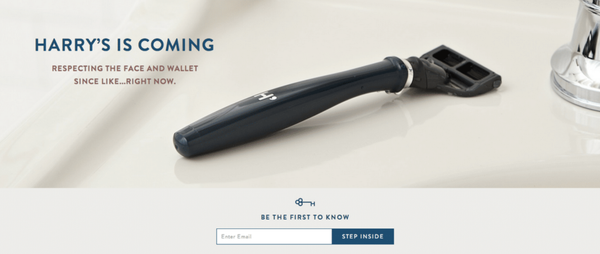
Harry’s, the men’s razor startup, launched a two-page pre-launch experience. The first page was a simple splash with a large product photo, playful copy (“Harry’s is coming. Respecting the face and wallet since like… right now.”) and an email input with a “Step Inside” CTA. The second page revealed a referral dashboard with tiered rewards: refer five friends for a free shaving cream, refer 25 for a razor set, refer 50 for a year of free blades.
What the Page Did
- Used the “Step Inside” CTA framing to make visitors feel like insiders entering an exclusive space
- Tiered the referral rewards so there was always a next incentive to chase
- Matched the copy and visual tone exactly to the brand identity before a single product shipped
Why It Worked
Harry’s collected 100,000 email subscribers in seven days without paid advertising. The founders started by emailing their own contacts, who shared with theirs and the referral loop compounded from there. By launch, they had a ready-made customer base and a validated brand voice.
Key Takeaway
Tiered referral rewards that align with your actual product, free razors for a razor brand, outperform generic gift cards or discounts because they reinforce what visitors already want.
6. Monzo
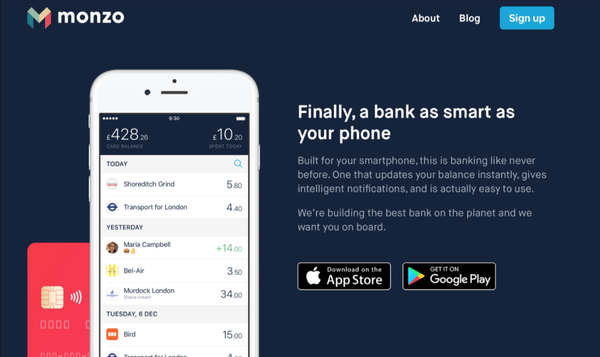
Monzo, the UK digital bank, combined a traditional email waitlist with a gamified queue mechanic and an innovative “Golden Ticket” system. When a new user joined the waitlist, they immediately saw their position in the queue. Referring friends moved them forward. After two weeks of using the account, each user received one Golden Ticket to share with a friend who could skip the queue entirely.
What the Page Did
- Showed each user their exact queue position immediately after signup, triggering competitive instinct
- Limited early access to the first 4,000 signups, creating real scarcity
- Gave the waitlist crowdfunding integration so early supporters could also become investors
Why It Worked
Monzo raised £1 million in crowdfunding in 96 seconds. The Golden Ticket system alone drove approximately 40% of signups in 2017 at zero cost, according to founder Tom Blomfield. The physical pink Monzo card also became a walking advertisement: every time someone used it in public, it generated curiosity and more referrals.
Key Takeaway
Make your queue position visible and moveable. Showing people exactly where they stand and exactly what it takes to move up, turns passive subscribers into active promoters.
7. Clubhouse
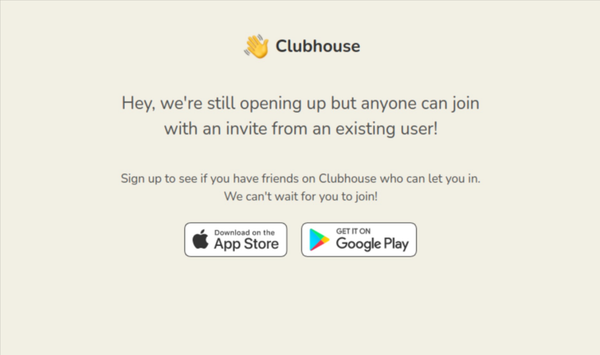
Clubhouse’s pre-launch page was deceptively simple: a minimal email signup form with a brief explanation of the audio-only social network concept. The real strategy happened after signup. Each user received a very limited number of invitations to share. High-profile early users, including Barack Obama and Elon Musk, were seeded deliberately to generate press coverage and amplify demand.
What the Page Did
- Used extreme invite scarcity: each user received just two initial invitations
- Seeded the app with celebrities and high-profile individuals to create social proof at scale
- Made exclusivity the entire product experience, not just a marketing tactic
Why It Worked
Clubhouse built a waitlist of more than 10 million people. Invitations were selling on eBay for up to $400 at peak demand. The platform reached a $4 billion valuation within a year of launch. The coming soon page was minimal precisely because the invitation scarcity was doing the heavy lifting.
Key Takeaway
If you can create genuine scarcity, you do not need a complex landing page. The harder something is to get, the more desirable it becomes. Controlled access is itself a growth strategy.
8. Notion
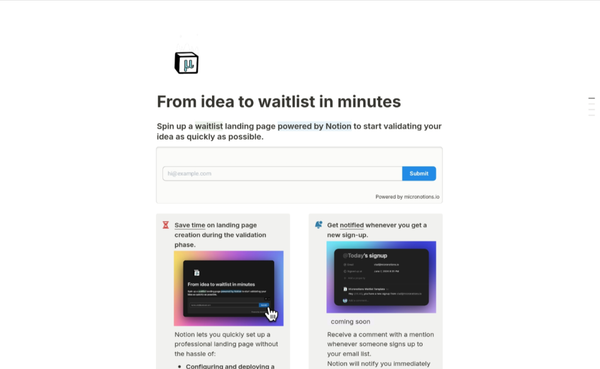
Notion’s pre-launch page went through several iterations, but its most influential pre-launch push featured a clean, educational design that explained the all-in-one workspace concept clearly with product visuals and use-case breakdowns. The page focused on community: early users were invited to contribute templates, shape features and participate in building the product alongside the team.
What the Page Did
- Gathered 20,000 beta signups before launch by making early users feel like co-creators rather than just customers
- Used community-building as the core mechanism, creating a sense of ownership among early adopters
- Collected feedback directly through the pre-launch experience to prioritize the right features
Why It Worked
Notion grew from 20,000 beta signups to 1 million users, eventually reaching a $10 billion valuation. The community-first approach meant launch day was not the beginning of a relationship with users. It was the culmination of one that had been building for months.
Key Takeaway
Involve your early audience in the product. People who helped shape something are far more loyal to it at launch than people who were simply notified that it was ready.
SaaS and Tech Coming Soon Pages
These pre-launch landing page examples from software companies show how to clearly communicate a complex product clearly enough to generate demand before a single line of production code ships.
9. Buffer
Buffer’s founder Joel Gascoigne validated the product with a two-page pre-launch site before writing a single line of code. The first page described what Buffer would do: schedule social media posts simply. Visitors who clicked “Plans and Pricing” reached a second page explaining the tiers. Clicking any pricing option led to a message saying the feature wasn’t ready yet, along with an email signup to be notified.
What the Page Did
- Used a fake pricing page to validate whether visitors were willing to pay, not just sign up for free
- Confirmed product-market fit before building the product itself
- Kept both pages to plain text with minimal design: no distractions, just the proposition
Why It Worked
Buffer grew to over 100,000 users using this validation-first approach. The two-page pre-launch site proved real intent before any engineering time was spent. It became one of the most cited examples of using a landing page before launch to test demand rather than just collect emails.
Key Takeaway
Use your coming soon page to validate willingness to pay, not just interest. A visitor who clicks a pricing option is a far stronger signal than one who hands over an email address.
10. Slack
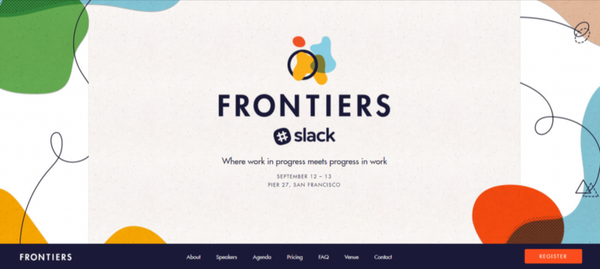
Slack’s pre-launch strategy was invitation-only and friend-driven. The founding team reached out personally to companies they knew and asked them to try the product. Early users then invited their own networks. The waitlist page was minimal: a straightforward explanation of what Slack did and a way to request access.
What the Page Did
- Relied on personal relationships and warm introductions rather than public advertising
- Prioritized getting teams, not individuals, to sign up, since the product only worked with others
- Collected 8,000 signups on the first day, driven by product hunt coverage and direct outreach
Why It Worked
Slack grew from 8,000 users on day one to 500,000 daily active users within 24 hours of public launch and reached a $1 billion valuation within 13 months. The personal invitation approach meant early users were pre-qualified, already understood the product and were more likely to bring their entire team aboard.
Key Takeaway
For collaboration tools, the unit of adoption is a team, not an individual. Design your pre-launch strategy around getting groups into the product together rather than signing up lone users.
11. Airtable
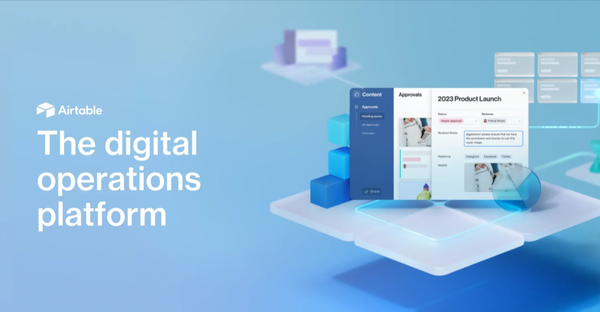
Airtable’s pre-launch page positioned the product as a spreadsheet that anyone could use like a database. The design was clean and functional, showing the interface directly on the page alongside a short explanation of the core concept. An early access form sat below the product screenshots.
What the Page Did
- Showed the actual product interface rather than illustrative icons or abstract graphics
- Positioned the product against a well-known tool (the spreadsheet) to make the concept instantly understood
- Used “request early access” rather than “sign up” to create a slight sense of selectivity
Why It Worked
Airtable’s approach of showing the product working, before launch, removed the most common reason people hesitate to join a waitlist: uncertainty about what they are actually signing up for. Early users arrived on day one already knowing what the product looked like and what they planned to use it for.
Key Takeaway
Show your actual product interface on your pre-launch landing page. Early access users who can see what they are waiting for convert at higher rates and churn at lower rates after launch.
12. Webflow
Webflow’s pre-launch page told the story of a problem before describing the solution. It opened with the frustration of building websites: the gap between design and code. Then it introduced Webflow as the bridge. Two CTAs ran in parallel: “Try Webflow for Free” and “Be one of the first to try it” with its own embedded form.
What the Page Did
- Used problem-first copywriting to create emotional resonance before the product was introduced
- Tested two CTA framings simultaneously to capture visitors at different levels of intent
- Embedded the signup form inline within the secondary CTA section to reduce friction
Why It Worked
Having two distinct conversion paths on the same page meant Webflow captured visitors who were ready to act immediately and those who needed the exclusivity angle to commit. The storytelling approach kept visitors engaged long enough to reach either conversion point.
Key Takeaway
Run two CTA framings in parallel on your coming soon page. A high-intent CTA and a softer, curiosity-driven one serve different segments of the same audience simultaneously.
What Makes These Coming Soon Pages Effective
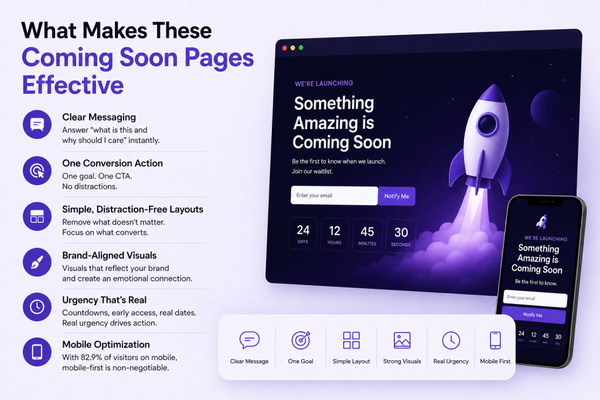
Looking across all 12 examples, the same principles appear on every page that worked:
Clear messaging within seconds
Every one of these pages answers “what is this and why should I care” before the visitor can even think of leaving. A vague headline is the most common reason coming soon pages fail to convert
One conversion action
No competing CTAs, no navigation links pulling visitors away, no sidebar content. The best coming soon page design removes everything that does not directly support a single goal
Simple, distraction-free layouts
The top performers are often the ones who removed the most elements, not the ones who added more. Simplicity reduces cognitive load and shortens the path to conversion
Brand-aligned visuals
Whether it is Calm’s soft color palette, Framer’s animated interactions, or Suta’s cultural photography, visuals communicate brand identity instantly. That emotional impression lands before any copy is read
Urgency that is real
Countdown timers, deposit mechanics, limited early access slots and specific launch dates all create genuine urgency. Manufactured scarcity tends to backfire; real timelines work
Mobile optimization
With 82.9% of landing page visitors arriving on mobile (SEO Sherpa, 2025), a coming-soon page that is not fully functional on mobile is actively losing potential subscribers.
That’s how effective a coming soon page can be.
How to Create a Coming Soon Page Like These Examples
Building a coming soon page that actually captures leads is a five-step process. Here is how to approach each one:
Step 1: Define your single goal
Are you building an email list, validating demand with a small deposit, capturing waitlist signups, or driving pre-orders? Your goal determines every design decision that follows. Do not try to do more than one thing.
Step 2: Write a problem-first headline
Lead with the pain your audience recognizes, or the outcome they want, not with your product name. “The family calendar that actually gets used” is a headline. “Introducing ProductName” is not.
Step 3: Add a focused form or CTA
One action per page. Two fields maximum on the form, email and at most one other. Place the form above the fold so it is visible without scrolling. Make the button copy specific: “Get Early Access” outperforms “Submit.”
Step 4: Strip the layout down
Remove the main site navigation. Remove links that lead off the page. Remove any section that does not directly support your conversion goal. If you are unsure whether an element belongs, remove it and test.
Step 5: Test on real mobile devices
Not just browser resizing, but actual phones. Check load speed, form functionality, button tap size and text readability. More than half of your early visitors will arrive on mobile and a clunky mobile experience will cost you signups regardless of how good the desktop version looks.
Using a Coming Soon Plugin for WordPress to create coming soon landing pages
Setting up a coming soon page manually requires custom development time, cross-device testing, email marketing integration and the ongoing risk that your in-progress site gets accidentally exposed to public visitors. A dedicated plugin handles all of that infrastructure so you can focus on the strategy.
Here is what a purpose-built WordPress coming soon plugin gives you that a manual setup does not:
- Instant activation with a single toggle, no development required
- Pre-built templates that match proven coming soon page design patterns
- Built-in email capture integrated with major email marketing platforms
- Access control so your team can keep building while the public sees the placeholder
- Correct HTTP status codes applied automatically for SEO protection
- Analytics to measure how your pre-launch page is actually performing
How Launch Guard Works for Coming Soon Pages
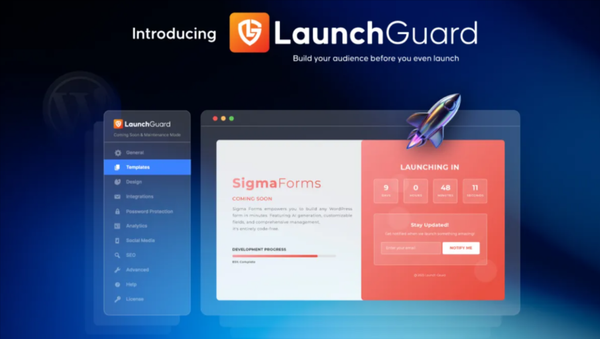
Launch Guard is a WordPress coming soon and maintenance mode plugin from BdThemes. Rather than just hiding your site behind a blank screen, it gives you a full set of tools to make the pre-launch period productive.
Here is what Launch Guard includes:
Templates
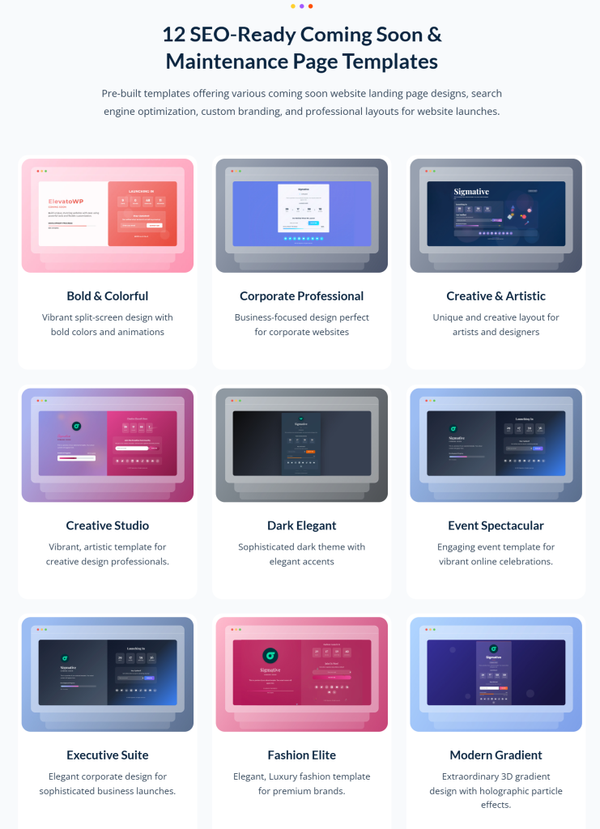
- 12 SEO-ready coming soon and maintenance page templates available out of the box
- Styles include Bold and Colorful, Corporate Professional, Creative and Artistic, Creative Studio, Dark Elegant, Event Spectacular, Executive Suite, Fashion Elite and Modern Gradient
- Each template is fully responsive and can be previewed and compared before activating
- A custom template builder is included if none of the ready-made options fit your brand
- Design customization covers color schemes, typography, background image upload, logo placement and layout options
Access Control
- Toggle coming soon mode on or off with a single switch from the WordPress dashboard
- Choose between two modes: Coming Soon (returns a 200 status code for SEO indexing) and Maintenance Mode (returns a 503 status code to signal temporary unavailability)
- Bypass access by user role so your team can view and work on the live site while public visitors see the placeholder
- Password protection with session management, auto-logout timers and custom hint text
Lead Capture and Integrations
- Direct Mailchimp integration for capturing subscriber emails straight into your marketing list
- API key configuration with list ID management
- Contact forms and social media link support built into the template layer
Analytics
- Real-time visitor tracking
- Signup tracking and performance metrics
- Time-based and geographic analytics
- Data export in CSV and JSON formats
SEO
- Meta tag management including title, author and description fields
- Google Analytics tracking configuration
- Custom HTML tags for advanced tracking needs
- Search engine visibility control per mode
Launch Guard starts at $19 per year for a single site, $49 per year for five sites (Business) and $199 per year for up to 1,000 sites (Agency). Lifetime plans are also available. There is a free trial with no credit card required.
Conclusion
A coming soon page is not a parking notice. It is the first chapter of your launch story and the brands that treat it that way consistently outperform those that treat it as an afterthought.
The 12 examples above show that there is no single formula for a great coming soon landing page. Linear used text and nothing else. Hearth Display charged a deposit. Storylane let visitors interact with the product before it existed. What every example shares is intention. Every element on the page served a purpose. Every design decision supported the goal.
The simplest coming soon page ideas, a clear headline, a single focused form and a real reason to care, tend to produce the best results. If you are building on WordPress, Launch Guard removes the technical barriers so you can focus on the strategy and the story.
Your pre-launch phase can be one of your most powerful growth windows. The brands with full waitlists on day one recognized that and they built accordingly.
Frequently Asked Questions
Do coming soon pages help build an audience before launch?
Yes, significantly. A well-designed coming soon page can capture email subscribers, validate demand and generate brand awareness before a single product is available. Hearth Display built a waitlist of more than 150,000 people before launch using only its pre-launch page. Robinhood collected nearly one million signups. The key is giving visitors a compelling reason to sign up, not just informing them that something is coming.
How long should a coming soon page stay active?
Most pre-launch pages perform best when they are live for four to twelve weeks before launch. Long enough to build a meaningful email list, short enough that anticipation does not fade into forgetting. According to pre-launch strategy research, the optimal window to start collecting signups is two to six months before your launch date (LaunchList, 2026). If your timeline extends beyond twelve weeks, keep the page active but continue sending regular updates so subscribers stay engaged.
What should you include in a pre-launch page?
At minimum: a clear headline that explains what is coming, a brief description of the core benefit and one conversion action such as an email signup or waitlist form. High-impact additions include a countdown timer with a real launch date, social proof such as press mentions or early user numbers, social media links and an early-access incentive like a discount or exclusive feature. Keep the layout to one page and strip out anything that does not support your single CTA.
Can you collect leads before your site is live?
Absolutely. That is the primary purpose of a coming soon page. You do not need a finished product or a complete website to start building your email list. A focused landing page with a working signup form is all you need before launch. Tools like Launch Guard make it especially straightforward on WordPress: install the plugin, activate coming soon mode, connect your Mailchimp account and you are capturing leads without any custom development.
Supreakshya Shrestha
The BdThemes team builds WordPress plugins trusted by 3M+ users worldwide. We write about web accessibility, WCAG compliance, and inclusive design.